Cottage Cheese at the End of the World
History likes to tell us that change is cinematic: grand speeches, powerful exits, dramatic confrontations. But the truth is far more disorienting.
Power doesn’t always evaporate with fireworks. Sometimes it leaves in silence, while a tray of peaches waits on a desk; a still life of the mundane colliding with the monumental.
In this week’s edition of Notes from the Wreckage, I reflect on Nixon’s final bowl of White House peaches, and the purpose in the mundane in this original piece: Cottage Cheese at the End of the World.
Before we jump in, I need to make a somewhat embarrassing admission: in high school, I went through a Nixon phase. A hyper fixation, really.…an obsession. I was a lonely Autistic kid with a library card and a grudge against power structures…and baby, Watergate? The tapes! The downfall?! I couldn’t get enough! (However, my teachers could; they kindly asked me to stop writing papers about Richard Nixon.)
While writing a Shatterpoint article* yesterday that included a reference to United States v. Nixon, I went looking for a public-domain photo from that era. I quickly discovered a huge library of archival images that documented Nixon’s last day in the White House, in full detail. I expected to find a good shot and get back to work.
I did not expect to lose forty minutes to a photograph of cottage cheese.
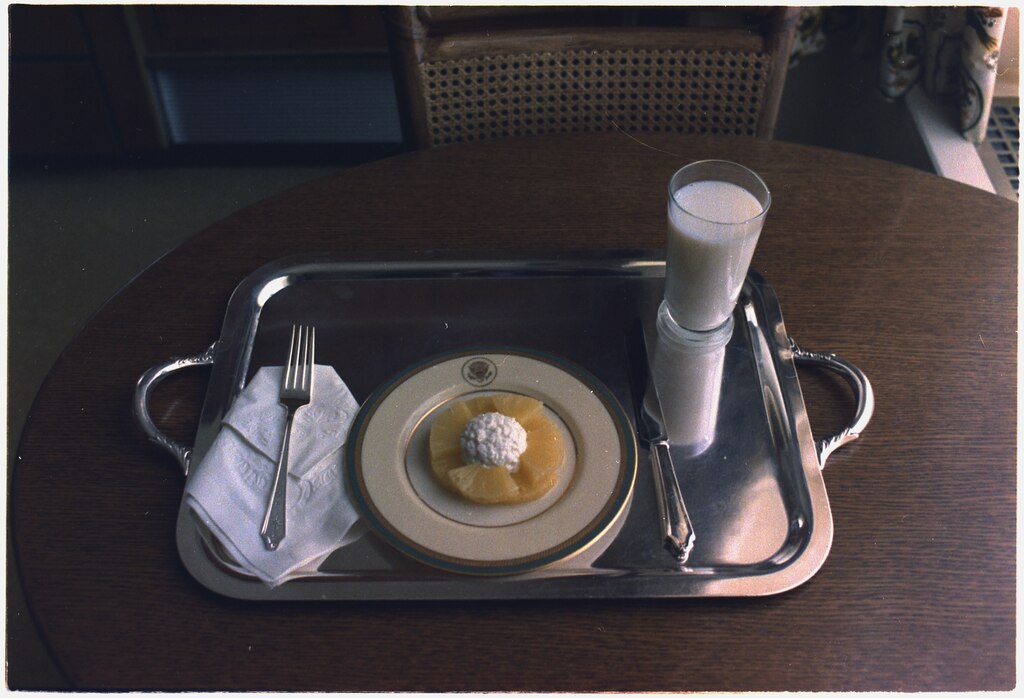
It was taken on Nixon’s last morning in the White House, in his final hours as president. The picture is an overhead shot of a tray: small lump of cottage cheese, sliced peaches, a glass of milk. That’s it. No Nixon. No drama. No emotional close-up of a man about to resign in disgrace. Just fruit and cold dairy under the colder, flat glare of archival lighting.
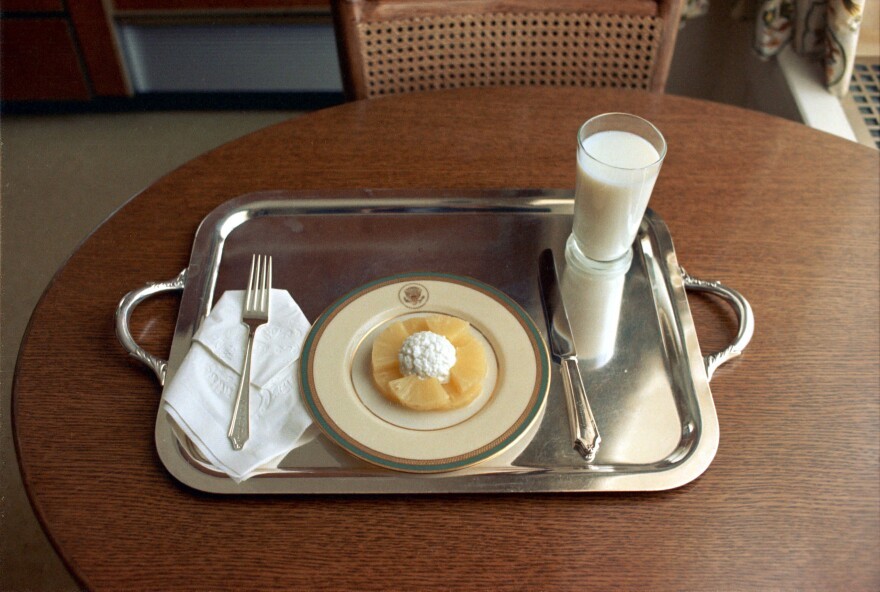
The energy is indescribable, really; mundane, awkward, almost voyeuristic in its stillness. Like history paused to take note of something important, and instead of a person… it found, well, breakfast.
I don’t know if Nixon ever ate it. For me, that’s not the point. What gets me is that someone had to prepare it. That morning, while the nation braced for the first and only presidential resignation in U.S. history, a White House staffer still woke up, put on their uniform, and plated cottage cheese.
Someone sliced the peaches. Someone balanced the milk on the tray. Someone walked it through the White House (through swirling panic, through whispered updates, through inevitable career uncertainty, most likely) and placed it on the table of a man whose entire world was rightfully collapsing. And then…someone photographed it.
A government photographer, with a checklist and a directive to document the day, looked at that yet to be touched tray and thought: Yes. This, too, is history.
I can’t stop thinking about it, 24 hours later.
It made me reflect on how behind every monumental moment are people whose jobs are not to be remembered. The photo isn’t about Nixon. It’s about the people around him. The kitchen worker who arranged the fruit. The person who wiped the rim of the glass. The photographer who framed the shot. The archivist who stored the image and labeled it as evidence of a long gone final day.
It also made me think about how, in moments of chaos or grief or consequence, our brains cling to something absurdly ordinary to notice in that moment. The loose thread on a shirt, or the hum of a fluorescent light, or a tiny bug making its way across the wall totally unimpressed by our suffering.
Or a tray of peaches during a constitutional crisis.
Our minds grab onto what hasn’t changed, because the alternative, acknowledging everything that has is too…big. The mundane becomes the eye of the hurricane.
Maybe that’s why I can’t stop thinking about this photo. It’s the banality of power leaving the room as the background characters of history do their jobs. It’s the sheer absurdity of documentation solely due to status. The government preserved this tray like it might later testify, or as if history’s most burning question from this day would be, “Well, what did he eat for breakfast!?”.
History likes to tell us that change is cinematic: grand speeches, powerful exits, dramatic confrontations. But the truth is far more disorienting. Power doesn’t always evaporate with fireworks. Sometimes it leaves in silence, while a tray of peaches waits on a desk; a still life of the mundane colliding with the monumental.
I’m left with so many things to wonder. I wonder what the photographer was thinking as they were taking it. I wonder if the staffer who placed that tray kept their job when the new administration arrived. I wonder if they remember that morning; not the resignation, not the speech…just the cottage cheese.
We are all living through moments we don’t realize are pivotal until much later. Especially these days. And often, when chaos hits, we cling to the closest normal thing and hold on. We should all take time to reflect regularly on these historical moments we are currently living through, and how life somehow continues in every mundane way around us because it simply must. We would all do well to remember that sometimes history is not the man in the room.
Sometimes history is a bowl of cottage cheese.
xx JJ
*article available for free upon publication on 11/7/25
 JJ Hastings
Leave a comment