As an ordained interfaith Minister who did my undergrad in Christian Ministry & Leadership at a traditional Bible college, and a lifelong advocate for the grassroots movement of Christ that exists outside of the mainstream Church, I felt compelled to root out Vance’s theological failures. Enjoy. – JJ
JD Vance has crafted a public identity rooted in Christian values, but beneath the surface, his political conduct tells a different story. While he quotes scripture and invokes faith to appeal to conservative voters, his policies and rhetoric align far more closely with the ambitions of Empire than the teachings of Christ.
In short: JD Vance preaches Jesus to the crowd but governs like Pontius Pilate, calculating, cruel, and eager to please the empire.

Christianity as Cultural Branding
Vance frequently presents himself as a defender of “traditional Christian values,” but his faith appears to function more as a political brand than a moral compass. His rise has been fueled by performative religiosity and populist appeals, rather than authentic Christian witness.
In his 2016 memoir, Hillbilly Elegy, Vance barely mentions Christianity at all. He uses it to frame the social and cultural dyanmics of Appalachia, but gives no strong theological values beyond his own witnessing of it. However, after his political ambitions crystallized, his public references to religion skyrocketed.
This shift mirrors a broader strategy among many on the New Right: use Christianity as a cultural weapon, not a source of conviction or humility.
For example:
In a 2025 speech at CPAC, Vance claimed that uncontrolled immigration was “the greatest threat” to both Europe and the United States, framing the issue in stark, apocalyptic terms that resonate with certain Christian nationalist narratives.
And despite being a Catholic convert, Vance’s meeting with the Vatican‘s secretary of state highlighted tensions between his political stances and the Church’s teachings, particularly on issues like immigration.
Power Over Principle: The Pilate Paradox
Pontius Pilate was the Roman governor of Judea during the early first century, best known for overseeing the trial and execution of Jesus of Nazareth.
According to the Christian Gospels, Pilate found no legal fault in Jesus but allowed him to be crucified anyway, bowing to pressure from religious leaders and a hostile crowd.
In a symbolic gesture, Pilate famously “washed his hands” in front of the crowd to claim he was not responsible for Jesus’ death—an act that has since become shorthand for cowardly denial of accountability.
For those outside the Christian tradition, Pilate represents a figure of political weakness and moral compromise. Rather than standing up for justice, he prioritized maintaining his power and appeasing the masses.
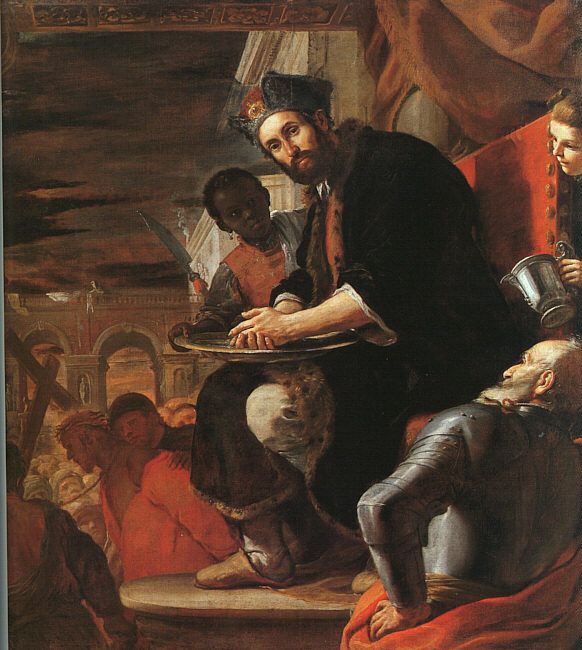
His legacy has endured as a cautionary tale about leaders who claim neutrality while enabling oppression: those who, in protecting their own interests, sanction the very injustices they pretend to reject.
Like Pontius Pilate, Vance washes his hands of responsibility for the harm done under his watch, posturing as a reluctant participant while enabling the machinery of cruelty.
Christ’s ministry challenged empire, hierarchy, and the hypocrisy of the religious elite. Yet Vance’s politics reinforce those very systems:
On immigration, Vance has called for an end to birthright citizenship and compared immigration to a “war on Western civilization“—rhetoric rooted in fear, not hospitality or compassion. An ironic view from a man who has tied the weight of his soul to a family of immigrants whose only Son was born “out of country”.
On punishment, Vance has supported tough-on-crime rhetoric while remaining silent about racial injustice and mass incarceration, despite scripture’s repeated calls to free the prisoner and seek restorative justice (see Matthew 25:36).
“Mammon” in the Senate
The word “Mammon” comes from an Aramaic term meaning riches. In the New Testament, Jesus uses it to refer to wealth in opposition to God. For example, in Matthew 6:24, he says: “You cannot serve both God and Mammon,”meaning one must choose between serving a higher moral purpose or being enslaved by materialism.
Vance’s economic ideology also betrays the gospel. Vance doesn’t just ignore the Biblical warning that “you cannot serve both God and money”, he actively campaigns on it.
Despite Jesus’ clear denunciation of wealth as a spiritual hazard, Vance has built his career in venture capital and continues to support policies that favor the rich at the expense of the working poor. He has surrounded himself with a powerful cadre of elites whose wealth also will not “fit through the eye of a needle”.
His rise has been backed by billionaire investor Peter Thiel, who donated ten million dollars to an outside group funding Vance’s Ohio Senate campaign. Thiel, a billionaire tech investor and co-founder of PayPal, has funneled millions into right-wing candidates and causes that often undermine democratic institutions, support authoritarian tendencies, and oppose social justice movements.
He is widely criticized for leveraging his immense wealth and influence to promote anti-democratic and regressive political agendas. Thiel’s backing of surveillance technologies, efforts to weaken antitrust enforcement, and vocal support for divisive political figures reveal a pattern of prioritizing power and profit over equity, transparency, and the public good. The antithesis of Christ’s message for a all embracing society.
Vance also co-founded Narya Capital, a venture capital firm with backing from Thiel and other tech billionaires, further entrenching his ties to wealth and power.
Pharisees, Not Prophets
Vance often paints himself as a moral crusader, yet his public conduct suggests a fixation on control and punishment. Values, quite frankly, more in line with the Pharisees than with Christ. Like the religious leaders Jesus rebuked in Matthew 23, Vance enforces public piety while neglecting “justice, mercy, and faithfulness” (see Matthew 23).
His support for book bans, anti-trans legislation, and a narrow, nationalistic version of Christianity is evidence of a theological framework that prizes purity and conformity over love and liberation, as well as a weak commitment to the demanded sacrifices of “speaking for” Christ.
A Christianity Without Christ
Ultimately, JD Vance’s version of Christianity lacks the core of Christ’s teachings.
It’s a civic religion dressed in scripture, a tool to consolidate power rather than to transform hearts. It is the most deviant and blasphemous form of spiritual manipulation and propaganda that only leads his followers away from the true message of Jesus Christ. No different than the Deutsche Christen, a religious group that existed in Germany between 1932 and 1945, and saught to drive Christians towards the antisemitic, racist, and Führerprinzip ideological principles of Nazism.
The Jesus of the Gospels preached love for the foreigner, healing for the sick, freeedom for the oppressed, and humility in leadership. He didn’t back empire, wealth, or fear-driven politics. Hundreds of thousands of tomes of information and analysis have been written about Christ’s foundational message of unity.
If Vance followed Christ rather than invoking His name, his policies—and priorities—would look very different.
xx JJ
All sources hyperlinked directly into article.
 JJ Hastings
Leave a comment