I absolutely love wrestling. I watch AEW, ROH, New Japan, Stardom, NOAH, CMLL, AAA, MLW, GCW, and now recently Indian promotion WXM. I need to make it clear that if I Wasn’t making educational and political content, I would absolutely with 0 hesitstion by a wrestling journalist.
There is a point at which “it’s just entertainment” stops being a neutral position and starts becoming a willful lie. WWE crossed that point years ago, and at this stage, pretending otherwise isn’t naïveté…it’s denial.
Recently, someone I genuinely respected choose to go work for WWE, a choice that didn’t just feel disappointing like times in the past, but unethical.
That reaction wasn’t abstract. It was sharpened by something specific: the recent release of Epstein-related Department of Justice documents in which Ashley Massaro’s name appears.
To be clear, and to be responsible: Massaro’s name appears in an anonymous Epstein-era complaint, one of the millions of pages recently released by the Department of Justice. The document itself is heavily redacted and unverified, but the context is clear: Ashley Massaro is mentioned alongside other young women described as being exposed to harm in elite networks. She is placed in proximity to abuse, not as a subject of wrongdoing, but as someone whose life intersected with systems designed to exploit and protect the powerful.
This is not speculation. It is the same pattern we see again and again: women made vulnerable inside one abusive institution show up in another, because the mechanisms that enable elite men to act with impunity are consistent across industries, decades, and continents.
Her appearance in these files underscores the broader truth at the heart of this story: the same systems that failed her in WWE did not suddenly disappear elsewhere, and the consequences for women are very real. it forces a reckoning with how the same kinds of elite abuse ecosystems keep surfacing across industries, and how women caught inside them are treated as expendable.
WWE under Vince McMahon did not merely “have problems.” It functioned the way elite abuse ecosystems function. Not because the same crimes were proven to occur in the same ways as other infamous networks, but because the conditions were identical: extreme power imbalance; young women economically dependent on a single gatekeeper for money, status, and safety; non-disclosure agreements used as tools of control; and an institutional culture that treated sexual access as a perk of power rather than a violation of consent. When women spoke up, the institution closed ranks. When they suffered, the machine kept moving.
That matters, because abuse does not require a secret cabal to flourish. It requires insulation. It requires money. It requires proximity to power. And it requires the quiet, shared understanding that consequences are optional for the right people.
Ashley Massaro’s life and death sit squarely inside that reality. She was a contracted WWE performer who submitted a sworn affidavit alleging that she was drugged and sexually assaulted during a WWE tour, and that company leadership discouraged her from reporting it. Her claims were denied. The lawsuit stalled. The system protected itself. She died by suicide in 2019. WWE did not meaningfully stop, pause, or reckon.
For years, her story was treated as tragic but inconvenient: something sad that happened near the institution, rather than something that revealed how it operated. Now, with her name surfacing in Epstein-era documents, people are once again tempted to do the wrong thing: sensationalize her, and then dismiss the pattern entirely because it doesn’t allow them to continue their enjoyment of these human beings as a consumable product.
Ashley Massaro doesn’t need to be a “link” to Epstein to matter. Her story is connective because it shows how elite institutions repeatedly fail women in the same ways, across industries and decades.
Epstein’s network represents a more extreme, more criminally documented manifestation of those dynamics. WWE represents a normalized, culturally sanctioned one. Different scale. Same mechanics. NDAs. Silence. Gatekeepers. Disbelief. The slow grinding down of women who are inconvenient to power.
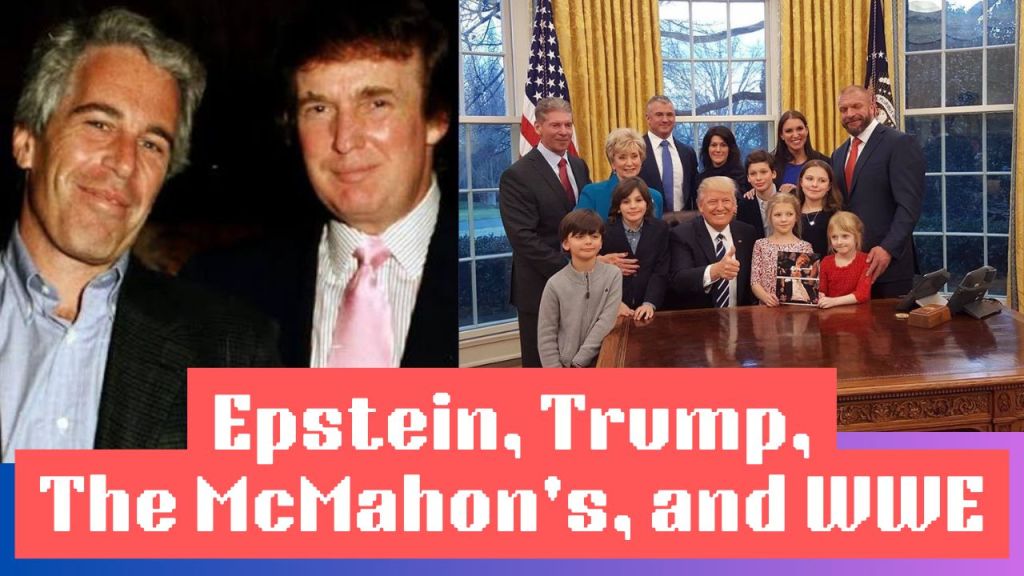
Politics enters this picture not through conspiracy, but through proximity and protection. WWE is adjacent to Trumpworld through Linda McMahon, who ran WWE during years when abuse allegations, abuse against both women AND small children, mind you, were surfacing internally and later became a major Trump donor and Administrator of the Small Business Administration, and now runs the Department of Education with 0 qualifications or knowledge of the education system, or pedagogical expertise.
Donald Trump, separately and indisputably, had a long social relationship with Jeffrey Epstein, publicly praised him, and appears in flight logs and party photos (with all necessary legal caveats about what those do and do not prove). What ties these worlds together is not a secret plot, but a shared elite milieu where accountability was rare, silence was rewarded, and consequences were negotiable.
And none of this was, or is, subtle. Trump wasn’t a random celebrity cameo in WWE. He was folded into storylines, hosted events at his properties, and was publicly celebrated by the company long before he entered the White House. WWE talent and branding appear at the White House. The McMahon family moves seamlessly between corporate entertainment power and state power. We are expected to pretend this doesn’t matter only because pretending is easier than reckoning.
Which brings us to now.
In 2026, choosing to work for WWE is not an innocent career move made in a vacuum. It is a choice to lend credibility, labor, and fan goodwill to an institution with a documented history of silencing women, protecting abusers, and aligning itself with authoritarian politics. When you have other options (especially when you are not desperate, when you are already successful) claiming neutrality is not innocence. It is avoidance.
These power dynamics persist because too many people decide that the harm doesn’t affect them personally enough to matter. Because looking too closely might cost them access, money, or comfort. Because it’s easier to say “it’s just wrestling” than to admit that culture, politics, and power are entangled, and always have been.
That’s the part I find genuinely disgusting. Not ignorance. Not even disagreement. But the choice to look away while insisting on moral cleanliness.
Ashley Massaro does not need to be dragged into conspiratorial speculation to make this point. In fact, doing so would repeat the same harm that defined her treatment in life: turning a woman’s suffering into something disposable or inconvenient. Her story already tells us what we need to know. Systems like WWE do not fail accidentally. They fail by design.
And they persist because enough people decide that speaking plainly is more uncomfortable than staying quiet.
Neutrality has always protected power. Silence has always kept the machine running. And history is not confused about who pays the price. When you choose to align yourself with the systems that destroy, don’t be surprised when you too, get chewed up and spit out.
 JJ Hastings
Leave a comment