JJ Hastings
It is a damning indictment of the global conscience that, once again, the machinery of mass atrocity grinds forward, and the default international posture is not outrage or intervention, but a meticulously constructed denial. All the classical, verifiable hallmarks of a textbook genocide are there: the wholesale destruction of Gaza, the killing of tens of thousands, the deliberate creation of famine, and the horrifying rhetoric from high-ranking officials. Yet all being systematically minimized, rebranded, or simply ignored by powers who claim to champion human rights.
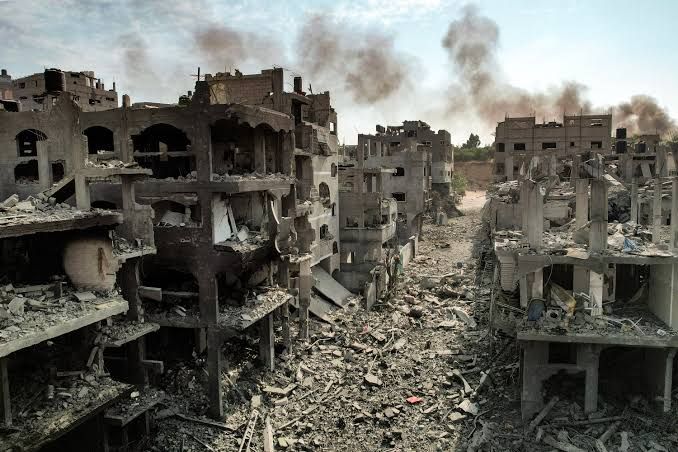
The question is no longer whether the violence is severe, disproportionate, or tragic. Those words are now rhetorical anesthetics. The uncomfortable, unavoidable, and increasingly urgent question is why so many people, particularly in the West, are so aggressively invested in denying the reality of a genocide unfolding in real time.
This is not a matter of legal ambiguity. The International Court of Justice, the highest judicial body in the world, has already found it plausible that acts committed by Israel in Gaza amount to genocide, triggering obligations under the 1948 Genocide Convention. That finding was not issued lightly, nor was it based on speculation or activist rhetoric. It was grounded in evidence: patterns of destruction, state conduct, and public statements by senior officials. And yet, even this has failed to puncture the protective shell of denial that now surrounds Israel’s actions.
The reason is not confusion. It is convenience.
Denial as Policy, Not Ignorance
Denial is often framed as a lack of information, as though the truth has simply failed to reach the right audiences. History tells us a different story, however. Genocide denial is not an absence of knowledge; it is an active political strategy.
Gregory H. Stanton, founding president of Genocide Watch and former president of the International Association of Genocide Scholars, identifies denial as the final stage of genocide. It is the stage in which perpetrators minimize crimes, attack accusers, destroy evidence, and recast victims as aggressors. Far from being a postscript, denial is integral to the crime itself. It ensures impunity and signals to the world that mass atrocity is survivable; politically, diplomatically, and morally.
This framework is not theoretical. It has been validated repeatedly by history.
The Armenian Genocide, in which approximately 1.5 million Armenians were systematically exterminated by the Ottoman Empire between 1915 and 1923, was documented exhaustively by diplomats, missionaries, and journalists as it occurred. The evidence was never in doubt. What followed instead was more than a century of denial by the Turkish state, reinforced by Western powers that chose geopolitical stability over historical truth. The United States, despite its own archival record, refused formal recognition for decades to avoid jeopardizing a strategic alliance. Denial functioned as a diplomatic lubricant, allowing business, military cooperation, and regional strategy to proceed unimpeded by moral reckoning.
Rwanda offers an even starker and more damning parallel. In 1994, as nearly a million Tutsis were slaughtered in a matter of weeks, U.S. officials contorted themselves linguistically to avoid the word genocide. Internal communications reveal deliberate efforts to describe “acts of genocide” without acknowledging genocide itself. The reason was painfully simple: under Article I of the Genocide Convention, recognition would have triggered a legal obligation “to prevent and to punish.”
Intervention carried risk. Denial was cheaper.
In both cases, the pattern was identical. The suffering of victims was weighed against the strategic interests of powerful states and found inconvenient. Silence, hedging, and euphemism became tools of policy.
What we are witnessing in Palestine is not a departure from this history. It is its continuation.
The Halo Effect of Historical Trauma
One of the most potent shields against accountability in this moment is the moral halo created by historical trauma. Israel was founded in the aftermath of the Holocaust, a genocide that permanently altered global consciousness and rightly reshaped international law. That history matters. But it has also been transformed into a form of moral immunity…particularly within Western political culture.
The unspoken logic is as corrosive as it is persistent: a people who were victims of genocide cannot, by definition, be perpetrators of genocide.
History offers no support for this belief. Victimhood does not inoculate against the exercise of extreme violence. Trauma does not prevent the abuse of power; it often distorts it.
Kenneth Roth, former executive director of Human Rights Watch, has warned explicitly about the weaponization of Holocaust memory.
The promise of “Never Again,” he has noted, has been selectively reinterpreted by some Israeli leaders to mean that anything is permissible in the name of preventing renewed persecution. Mass civilian death, forced displacement, and the destruction of an entire society are reframed as tragic necessities, shielded by historical suffering rather than judged against it.
For many Western supporters, acknowledging genocide in Palestine would not simply indict Israeli policy. It would force a reckoning with decades of unconditional support, military aid, and diplomatic protection. It would expose the fiction of moral exceptionalism; not just Israel’s, but the West’s.
Denial, in this sense, is not about protecting Israelis from criticism. It is about protecting Western identity from collapse.
Legal Hair-Splitting as Moral Evasion
Modern genocide denial rarely takes the form of outright rejection. Instead, it hides behind law. Specifically, a bad-faith obsession with definitional purity.
“It’s horrific,” the argument goes, “but it’s not genocide.”
This posture relies on widespread misunderstanding of the Genocide Convention itself. The Convention does not require the intent to destroy an entire group. It requires intent to destroy a protected group in whole or in part. It explicitly includes not only killing, but the deliberate infliction of “conditions of life calculated to bring about its physical destruction.”
The systematic destruction of Gaza’s food supply, healthcare system, housing, water infrastructure, and civil institutions fits squarely within that definition. So does the mass displacement of its population and the explicit articulation of policies designed to make the territory uninhabitable.
Nor is genocidal intent some unknowable internal state. International law recognizes intent through patterns of conduct and public rhetoric. And here, the intent is not a hidden secret; it has been articulated with horrifying clarity by officials themselves.
References to Palestinians as “human animals” and the declared goal of the total destruction of the territory demonstrate what legal scholars call dolus specialis: the specific intent to destroy a group, in whole or in part.
The invocation of “self-defense” does not negate this. Even lawful self-defense is constrained by international humanitarian law. It does not permit collective punishment, starvation of civilians, or the destruction of an entire society. To argue otherwise is not a legal defense. It is an admission that some lives are expendable in service of state power.
The ICJ and the Limits of Denial
The International Court of Justice’s ruling in South Africa v. Israel marked a critical rupture in the architecture of denial. The Court found it plausible that genocidal acts were occurring in Gaza and issued provisional measures aimed at preventing further harm. This was not a verdict on the final merits, but it was a recognition that the threshold for genocide had been crossed sufficiently to demand immediate restraint.
That finding should have shifted the conversation. Instead, it was treated as an inconvenience; acknowledged briefly, then sidelined. The legal authority of the Court was respected in form and dismissed in substance. The message was unmistakable: even when the world’s highest judicial body raises the alarm, political will can still override law.
The True Cost of Acknowledgment
Ultimately, the denial of genocide in Palestine is not about evidence or uncertainty. It is about cost.
For the United States and its allies, recognition would trigger legal obligations under international law. It would require an immediate reassessment of military aid and diplomatic cover. It would expose the hollowness of decades of rhetoric about human rights, democracy, and a “rules-based international order.” It would confirm to the Global South what many already understand: that these principles are applied selectively, when they align with Western interests.
Domestically, recognition would confront a deeply entrenched bipartisan consensus, reinforced by a powerful political infrastructure that has long insulated Israel from accountability. The machinery of influence is well-oiled: AIPAC and its affiliated political action committees pour hundreds of millions into U.S. politicians’ campaigns, ensuring loyalty through funding, endorsements, and behind-the-scenes pressure. Any lawmaker considering action in support of Palestine must weigh the immediate political consequences of angering this network.
And the structural barriers are even higher under the current Trump administration, which has made any U.S. policy perceived as favorable to Palestinians nearly impossible. The administration’s ideological alignment, coupled with its reliance on mega-donor influence, guarantees that political incentives are stacked overwhelmingly against any acknowledgment or meaningful intervention.
Denial is simply cheaper. It allows leaders to issue vague calls for “humanitarian pauses” while weapons continue to flow. It allows media institutions to perform balance while one population is annihilated.
It allows the public to remain psychologically comfortable, reassured that history will be kind to their restraint. History never is.
Coming Back to the Word We Were Told Not to Use
Genocide is, indeed, a serious word. It always has been.
What should unsettle us is how often seriousness is invoked not to confront atrocity, but to delay recognition until it is safely in the past tense. Genocide, it seems, is easiest to name when there is nothing left to prevent; only memorials to build and apologies to issue.
To those who continue to deny what is happening in Palestine: this is not skepticism. It is complicity. You are standing on a shoreline crowded with historical ghosts, insisting the water is an illusion while bodies wash in.
From Palestine to Armenia to Rwanda (and Cambodia*, East Timor*, Guatemala*, Bosnia*, Darfur*, the list goes on) history shows the same pattern: political, strategic, and social expediency routinely trumps acknowledgment of genocide.
Powerful nations excuse mass atrocity when the perpetrator serves a strategic purpose. Alliances are prioritized over humanity. Stability is valued more than life.
The reality of genocide in Palestine is denied not because the evidence is thin, but because the political will to act is absent.
For the rest of us, for those who insist on telling the truth even when it is professionally dangerous, the task is not to soften our language until it becomes acceptable. It is to speak with enough clarity that denial becomes shameful rather than safe.
“Never Again” was not meant to be a slogan for the past. It was meant as a warning.
And warnings, by definition, are meant to be heard in time.
Post Notes
Scope and Limitations
This essay is a work of political and legal analysis, not a judicial ruling. It does not attempt to catalogue every atrocity, statement, or data point related to Gaza, nor does it substitute for ongoing legal proceedings. Its purpose is to assess whether the denial of genocide is credibly grounded in evidence, or whether it reflects historical patterns of political avoidance observed in prior cases of mass atrocity. All factual claims are drawn from verifiable sources, established scholarship, or primary legal findings. Where interpretation is offered, it is explicitly tied to recognized legal and historical frameworks.
***
- Cambodia (1975–1979): The Khmer Rouge’s mass killings were initially underreported; global attention lagged because of Cold War geopolitics and skepticism of reports.
- East Timor (1975–1999): Indonesia’s occupation and the systematic killing of Timorese were largely ignored by Western powers to maintain regional alliances.
- Guatemala (1981–1983): The genocide against Indigenous Mayans under U.S.-backed regimes was downplayed to protect Cold War strategic interests.
- Bosnia (1992–1995): The Srebrenica massacre and broader ethnic cleansing were initially minimized due to European political hesitation and fear of military entanglement.
- Darfur, Sudan (2003–present): The genocide and mass displacement were widely ignored or described as “tribal conflict” to avoid intervention and economic disruption.
Sources
- Gregory H. Stanton, The Ten Stages of Genocide (Holocaust Memorial Day Trust). Framework identifying denial as the final stage of genocide.
- International Court of Justice, South Africa v. Israel (January 2024). ICJ finding that it is plausible acts of genocide are being committed in Gaza, triggering obligations under the Genocide Convention.
- Kenneth Roth, The Challenge of Proving Genocide. Analysis of genocidal intent, legal standards, and the misuse of Holocaust memory in contemporary human rights discourse.
- Julien Zarifian, The United States and the (Non-) Recognition of the Armenian Genocide. Analysis of how Western geopolitical interests enabled long-term denial of the Armenian Genocide.
- Cherice Joyann Estes, The Western Media and the Portrayal of the Rwandan Genocide. Academic analysis of U.S. and Western avoidance of the word “genocide” during the 1994 Rwandan Genocide to evade legal obligations.
 JJ Hastings
Leave a comment